

What’s the best AI for UPSC?
AI is changing UPSC preparation fast. But most aspirants are using it the wrong way.
They ask random questions, get long answers, feel productive… and still don’t improve their marks. The truth is simple:
AI is not a replacement for hard work.
But AI is a powerful tool to make your hard work more focused, faster, and exam-oriented.
This guide will show you exactly how to use AI for UPSC preparation in a practical, step-by-step way — for Prelims, Mains, Essay, and Interview.
Why AI Matters in UPSC Preparation
UPSC is not just about knowledge. It is about:
- coverage of syllabus
- revision efficiency
- answer writing practice
- current affairs integration
- smart note-making
- PYQ-based preparation
AI helps in all of these.
But the biggest advantage of AI is this:
AI reduces confusion and improves execution.
And execution is what UPSC rewards.
Can AI Replace Coaching for UPSC?
No.
But AI can replace many things aspirants depend on coaching for, such as:
- making structured notes
- organizing current affairs
- solving doubts instantly
- generating answer frameworks
- analyzing PYQs
- providing revision material
- evaluating answers (with limitations)
If used correctly, AI can make self-study aspirants almost as structured as coached aspirants.
Best Ways to Use AI for UPSC Preparation (Big Picture)
The best way to use AI is not “ask and read”.
The best way is to use AI as a system across the UPSC cycle:
The 5 AI Use-Cases That Matter Most
- Syllabus Breakdown + Planning
- Concept Learning + Doubt Solving
- Current Affairs → Notes → Mains Answers
- Answer Writing Practice + Evaluation
- Revision + Recall + Diagrams
Everything else is secondary.
Step-by-Step: How to Use AI for UPSC Preparation
Step 1: Use AI to Decode the UPSC Syllabus
Most aspirants underestimate the syllabus.
They read the PDF once and start studying randomly.
Instead, use AI to break the syllabus into:
- micro-topics
- linked current affairs
- PYQ relevance
- priority areas
Prompt You Can Use
“Break the UPSC GS2 Polity syllabus into micro-topics. For each micro-topic, give PYQ frequency, most asked angles, and sources.”
This instantly gives direction.
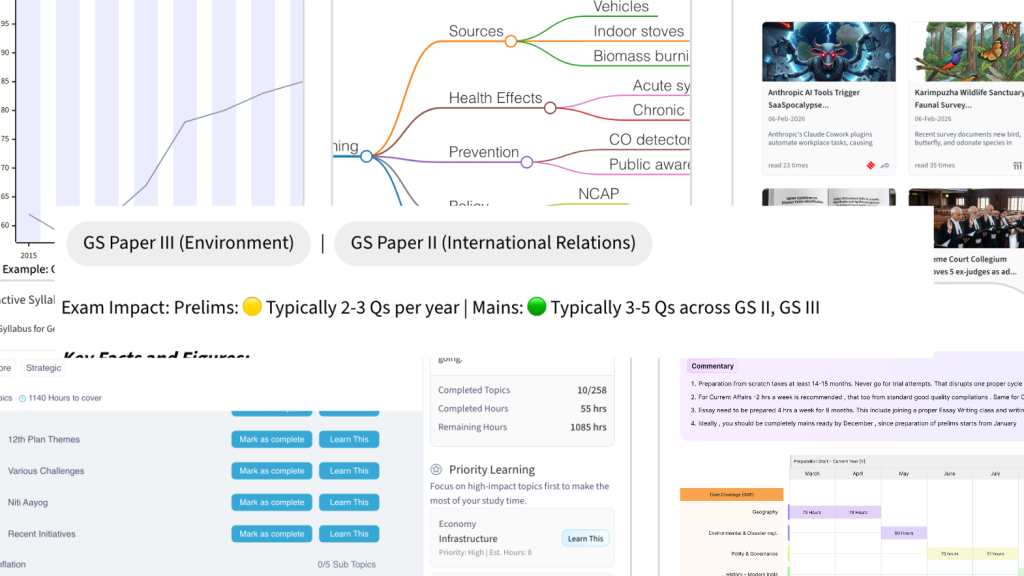
If you want an interactive syllabus experience, tools like Yooki offer structured topic navigation and tracking.
https://blog.askyooki.com/2025/12/31/why-a-static-upsc-syllabus-is-a-very-wrong-thing/
Step 2: Use AI to Build a Smart UPSC Study Plan
This is where AI becomes a real game-changer.
Instead of random schedules, AI can create:
- daily study blocks
- revision cycles
- test integration
- backlog buffer
AI UPSC Study Planner Prompt
“Create a 6-month UPSC study plan for Prelims + Mains. Include weekly targets, revision days, PYQ practice, and mock tests. Assume I study 6 hours/day.”
This gives structure instantly.
But remember: plans fail when they are unrealistic. Always keep buffers.
(Internal link suggestion: https://blog.askyooki.com/ai-upsc-study-planner)
Step 3: Use AI to Learn Faster (Concept Clarity)
AI works best as a doubt solver and teacher.
For subjects like Economy, Geography, Polity, Environment, and Science-Tech, AI can simplify concepts quickly.
Best Prompt for Concept Learning
“Explain ‘Monetary Policy Transmission’ like I’m a beginner. Then give a UPSC-ready explanation with examples.”
This two-level learning is powerful.
Pro Tip
Always ask AI for:
- definition
- examples
- diagram idea
- PYQ linkage
This makes the learning exam-oriented.
Step 4: Use AI for Notes Making (Without Creating Junk Notes)
Most aspirants misuse AI here.
They copy long answers into notebooks. That becomes useless.
AI notes should be:
- short
- structured
- revision-friendly
- fact-rich
- UPSC-ready
Best AI Notes Prompt
“Create UPSC short notes on ‘National Education Policy 2020’. Use headings: Introduction, Key Features, Pros, Challenges, Way Forward, Data/Reports, PYQs.”
This gives notes that can be revised in 10 minutes.
AI for UPSC Prelims Preparation
Prelims is not about knowledge. It is about:
- accuracy
- elimination skills
- repeated revision
- PYQ pattern recognition
AI can help massively if used correctly.
How AI Helps in Prelims
1. Topic-Wise PYQ Analysis
AI can analyze previous year questions and identify patterns.
Prompt:
“Analyze UPSC Prelims PYQs on Fundamental Rights (2013–2023). Give recurring themes and tricky areas.”
2. MCQ Practice With Explanations
AI can generate practice MCQs, but you must verify quality.
Prompt:
“Create 20 UPSC-standard MCQs on Directive Principles. Provide explanation and eliminate wrong options.”
3. Revision Sheets
Prompt:
“Create a one-page revision sheet for ‘Biosphere Reserves in India’ with locations, key facts, and memory tricks.”
Warning: Don’t Trust AI Blindly for Prelims Facts
This is crucial.
AI sometimes makes factual mistakes, especially in:
- geography locations
- environment species
- historical dates
- reports and rankings
So always cross-check with trusted sources like:
- NCERTs
- Spectrum/Laxmikanth
- PIB (https://pib.gov.in)
- PRS India (https://prsindia.org)
- official reports
AI for UPSC Mains Preparation
Mains is where AI becomes extremely powerful.
Because Mains is not just about content. It is about:
- structure
- dimensions
- balance
- examples
- case studies
- conclusion + way forward
AI is excellent at generating frameworks.
How to Use AI for Mains Answer Writing
Best Method: Ask AI for “Dimensions”
Prompt:
“Write a GS2 answer on ‘judicial activism’. Provide 6 dimensions: constitutional, political, governance, social, ethical, international. Include examples and way forward.”
This improves your answers instantly.
Use AI to Add Value in Answers
UPSC loves value additions like:
- committee names
- report references
- case studies
- data points
- Supreme Court judgments
- constitutional articles
Prompt:
“Give 10 value additions for an answer on ‘Women empowerment in India’. Include data, schemes, reports, and examples.”
AI for UPSC Answer Evaluation (Game Changer)
This is the biggest pain point for self-study aspirants.
Students write answers, but they don’t know:
- whether it is good
- how many marks it can get
- what is missing
- how to improve quickly
AI can help with evaluation if used properly.
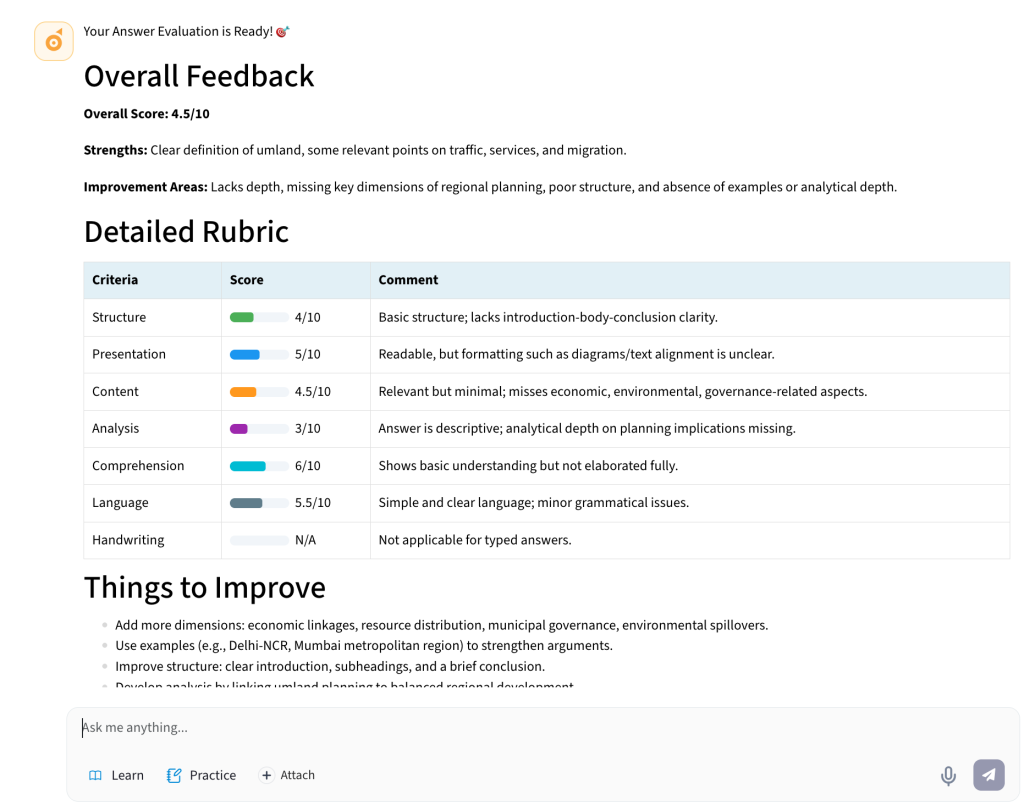
Best Evaluation Prompt
“Evaluate this answer like a UPSC examiner. Give marks out of 10. Provide feedback on structure, relevance, depth, examples, language, and conclusion. Then rewrite the improved version.”
This creates a feedback loop.
Platforms like Yooki go further by offering structured rubrics and exam-style evaluation experience.
(Internal link suggestion: https://blog.askyooki.com/ai-upsc-answer-evaluation)
AI for UPSC Essay Preparation
Essays are a major scoring opportunity.
AI can help in:
- brainstorming dimensions
- generating quotes
- creating structure
- improving flow
- creating examples
Best Way to Use AI for Essay
Step 1: Get Essay Framework
Prompt:
“Create a UPSC essay outline on ‘Technology is a useful servant but a dangerous master’. Include introduction hooks, 6 sections, examples, and conclusion.”
Step 2: Ask for Philosophical + Practical Balance
Prompt:
“Add philosophical depth and Indian examples to this essay outline.”
Step 3: Improve Language
Prompt:
“Rewrite this paragraph in simple but powerful UPSC essay language.”
AI for UPSC Current Affairs Preparation
Current affairs is where most aspirants waste time.
They read too much and retain too little.
AI can solve this by converting news into:
- mains notes
- prelims facts
- essay points
- case studies
- model answers
Best AI Workflow for Current Affairs
Prompt for Current Affairs Note
“Convert this news into UPSC-ready notes: Background, Significance, Challenges, Way Forward, Prelims facts, Mains angles, and possible questions.”
This is the most useful format.
Sources You Should Combine With AI
Use AI along with trusted sources like:
- PIB: https://pib.gov.in
- PRS: https://prsindia.org
- Economic Survey (Govt of India)
- Yojana/Kurukshetra summaries
- DownToEarth, IE Explained
AI can simplify these sources into exam notes.
AI for UPSC Interview Preparation
UPSC interview is about:
- personality
- clarity
- honesty
- balanced views
- communication
AI can help you practice mock interviews.
Best AI Prompt for UPSC Interview
“Act as UPSC interview board. Ask me 15 questions based on my DAF: graduation, hometown, hobbies, current affairs. Give feedback after each answer.”
This is highly effective.
Best AI Tools for UPSC Preparation (2026)
There are two categories:
1) General AI Tools
- ChatGPT
- Gemini
- Claude
- Perplexity
These are powerful, but not UPSC-specific.
2) UPSC-Specific AI Platforms
These platforms focus on syllabus structure, PYQs, tests, answer writing, evaluation, and exam relevance.
Example: AskYooki (Yooki) focuses on:
- interactive syllabus tracking
- planner + milestones
- exam toolkit workflow
- current affairs insights
- answer writing + evaluation
- curated tests
Website: https://askyooki.com
(Internal link suggestion: https://blog.askyooki.com/yooki-vs-chatgpt)
Biggest Mistakes Students Make While Using AI
1. Using AI like Google
AI is not search. It is a thinking assistant.
2. Copy-pasting AI answers into notes
This creates heavy notes and zero retention.
3. Not verifying facts
Prelims requires accuracy.
4. Using AI without PYQs
PYQs are the real syllabus.
5. Not building answer writing habit
AI can’t write your exam. You must practice.
The Best Way to Use AI Without Getting Distracted
Follow a simple rule:
AI should always produce an output that is exam-usable.
If it doesn’t give you:
- a note
- a revision sheet
- a framework
- a PYQ list
- a practice question
- an evaluated answer
…then you are wasting time.
A Simple Daily AI Routine for UPSC Aspirants
Here is a practical routine:
Daily (45–90 minutes with AI)
- 20 mins: learn 1 concept deeply
- 15 mins: convert it into notes
- 15 mins: write a 150-word answer
- 10 mins: AI evaluation feedback
- 10 mins: revise mistakes
This creates massive improvement over time.
FAQs: AI for UPSC Preparation
Is AI good for UPSC preparation?
Yes. AI is excellent for planning, notes, answer frameworks, revision, and doubt solving.
Can AI help in UPSC answer writing?
Yes. AI can provide structure, dimensions, examples, and feedback. But you must practice writing yourself.
Can AI give UPSC-level MCQs?
Yes, but quality varies. Always verify facts and difficulty level.
Which is the best AI tool for UPSC preparation?
General tools like ChatGPT are powerful, but UPSC-specific tools like Yooki provide better structure, evaluation, and exam-focused workflows.
Can AI replace coaching?
Not fully. But AI can provide a strong structure for self-study aspirants.
Final Thoughts: AI Won’t Clear UPSC. But It Can Multiply Your Chances.
UPSC is still about discipline.
But AI can make your discipline smarter.
If you use AI correctly, you will:
- waste less time
- revise faster
- write better answers
- cover syllabus systematically
- stay consistent
And that is what UPSC rewards.
Try a UPSC-Specific AI Workflow (Recommended)
If you want an AI system built specifically for UPSC, explore:
👉 AskYooki (Yooki): https://askyooki.com
📌 Blog: https://blog.askyooki.com
Because the future of UPSC prep is not just reading more.
It is learning in a loop:
Visualize → Memorize → Revise → Apply