

Every year, thousands of UPSC aspirants perform the same ritual. They collect current affairs. Then they collect more current affairs. Then comes the 1,000-page annual compilation—because apparently, if 300 pages are good, 1,000 must be excellent.
And finally, they walk into the Mains examination hall, see a question that looks vaguely familiar, and realise they have read about it fourteen times—and yet they cannot answer.
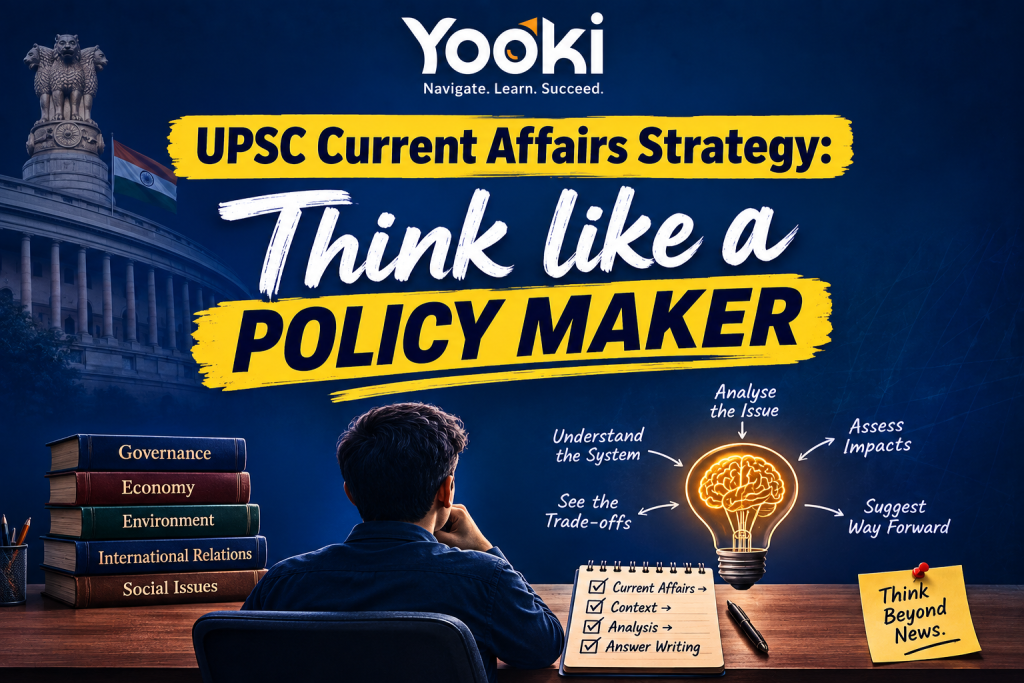
The problem is not lack of information. It is the wrong architecture of preparation.
UPSC Mains is increasingly not asking, “What happened?”
It is asking:
“Now that this has happened, do you understand the system around it?”
That is a very different sort of examination.
The Fundamental Shift: From Events to Systems
For a long time, Current Affairs preparation was largely event-driven.
- A scheme was launched → learn its objectives.
- A treaty was signed → learn its provisions.
- A technology was developed → learn its applications.
- A committee was constituted → remember its recommendations.
The preparation model was essentially:
EVENT → INFORMATION → MEMORY → ANSWER
But the nature of Mains has increasingly moved towards:
EVENT → STATIC CONCEPT → SYSTEM → TRADE-OFF → IMPACT → WAY FORWARD
The current event is merely the entry point. The real examination begins after that.
UPSC uses the news as a temporal hook to test whether you understand:
- the underlying static concept,
- the policy architecture,
- institutional capacity,
- implementation bottlenecks,
- competing interests,
- economic and social consequences,
- environmental implications,
- and the trade-offs involved.
In other words, Current Affairs is no longer a separate subject. It is the live laboratory in which your static knowledge is tested.
Then vs Now: The Quiet Transformation
The Earlier Pattern: Event-Driven Isolation
Questions often tested relatively discrete areas of awareness:
- What is it?
- What are its features?
- What are its objectives?
- What are its advantages?
The candidate who had good notes and a reasonably cooperative memory could survive.
The Emerging Pattern: Multi-System Integration
Now, a single question can quietly bring together:
Technology + Economy + Environment + Governance + Society + Policy + Implementation
And suddenly, your beautiful 47-page notes on the scheme are of limited use.
Because UPSC isn’t asking you to reproduce the scheme.
It is asking you to think through the scheme.
That distinction is the heart of modern Mains preparation.
Five Questions That Reveal the Shift
1. Agriculture: From Knowing a Scheme to Understanding an Ecosystem
An earlier-style question such as the 2016 question on National Agriculture Market (e-NAM) essentially asked candidates to explain what e-NAM was and discuss its advantages.
The preparation requirement was relatively straightforward:
What is e-NAM? → Features → Advantages → Conclusion
Now imagine the newer style of questioning around agriculture and technology in 2026 mains:
Q. Analyse the role of satellite-based technologies in achieving climate-smart agriculture and food security in India.
Suddenly, e-NAM-type scheme memorisation is nowhere near enough.
You need to connect:
Satellite technology
↓
Crop monitoring
↓
Weather forecasting
↓
Precision agriculture
↓
Resource efficiency
↓
Climate resilience
↓
Productivity
↓
Food security
↓
Supply-chain integrity
And importantly, notice the directive verb ‘analyse’. It demands that you don’t merely list what satellite technology can do. You should be ‘analysing’ its role. Analysis includes ‘why’ satellite technology can do better and also comment on how appropriate and effective it will be. Like, think what if govt has all data and intent but unable to execute agricultural solutions despite the satellites tech because it lacks gram connect and rural infrastructure on scale. Think of how satellite tech cannot address social discriminations on hunger and food security issues.
Therefore, question is no longer testing whether you know a programme.
It is testing whether you understand how different systems interact.
Agriculture is no longer just:
farmer → crop → market → hunger reasons
It is:
climate + technology + water + markets + logistics + information + finance + resilience + social system + practices + governance and delivery system.
That 360 deg operational lens.
2. Environment: From Institutional Roles to Institutional Consequences
Take earlier kinds of question on the role of NGOs in environmental protection.
A typical conventional answer writes as:
Awareness → Advocacy → Community participation → Litigation → Conservation
The newer approach pushes you further. Check this 2026 mains question:
Q. What role do environmental NGOs and activists play in influencing EIA outcomes for major projects in India? Cite concrete examples.
Now the candidate has to move across multiple layers:
- EIA framework
- environmental governance
- public consultation
- civil society
- activism
- administrative decision-making
- project implementation
- environmental justice
NGO is no longer simply an actor you describe. It becomes part of a governance ecosystem. And the examiner wants to know what happens when that ecosystem actually encounters a real project, competing interests and institutional constraints.
This is the difference between knowing who does what and understanding what their intervention does to the system.
3. International Relations: From Bilateral Laundry Lists to Geo-Economic Thinking
An older-style IR question could ask:
Discuss the key areas of cooperation between India and Japan.
The standard answer:
- Defence.
- Trade.
- Technology.
- Infrastructure.
- Indo-Pacific.
- People-to-people ties.
Add a few initiatives. Sprinkle in a strategic partnership. Finish with “India and Japan share a Special Strategic and Global Partnership.” Done!
But consider 2026 question:
Q. “The center of global trade is gradually shifting from the Atlantic region to the Indo-Pacific region. Examine the strategic and economic implications for India.”
Now the candidate must think spatially and strategically:
- Global trade flows
- maritime routes
- ports
- chokepoints
- supply chains
- manufacturing geography
- strategic competition
- Indo-Pacific
- India’s economic interests
This is no longer simply India–Japan relations.
It is about how the geography of globalisation is changing—and what India should do about it. ‘Examine the implications..’ has some meaning. It requires geography, economics, international relations, maritime strategy and domestic policy to speak to each other.
4. Health: From Scheme Objectives to the Gender Lens
Consider the earlier pattern around Ayushman Bharat:
What are the objectives of Ayushman Bharat? How will it impact healthcare delivery?
The natural answer structure:
Objectives → Components → Coverage → Benefits → Challenges → Way Forward
But now look at the following question from 2026 mains:
Q. Why is it important to take gender concerns into account in programme design and implementation? Discuss with special reference to public health policies.”
The question isn’t merely discussing healthcare. It’s asking:
- Who accesses healthcare?
- Who controls household resources?
- Who bears unpaid care work?
- Whose health needs are overlooked?
- Does policy design assume a gender-neutral citizen?
- Do implementation mechanisms reproduce existing inequalities?
The question has shifted from:
“What does the programme provide?”
to:
“For whom does the programme actually work, under what conditions and how can it be made more effective with gender centric approach?”
That is a much deeper question.
It moves from policy description to policy evaluation.
5. Infrastructure & Finance: From Definitions to Long-Term Evaluation
Earlier questions could ask:
What is Public-Private Partnership? How can PPP help infrastructure development?
Again, a familiar structure:
Definition → Models → Advantages → Problems → Solutions
But consider this:
Q. “Examine the pattern and trend of public expenditure on Social Services in the post-reforms period in India. To what extent has this achieved inclusive growth?”
Now you have to connect:
- Fiscal policy
- public expenditure
- social services
- health & education
- human capital
- inequality
- inclusion
- growth outcomes
And importantly, you have to distinguish between spending and outcomes.
Because spending ₹100 on something does not automatically mean ₹100 worth of development happened. ‘To what extent has this achieved..’ is a different anchor to operate from.
The examiner is essentially asking:
Did the policy produce the outcome it was supposed to produce?
So What Should You Do With Current Affairs?
The answer is surprisingly simple:
Stop reading Current Affairs as a newspaper. Start reading it as a syllabus trigger.
When you encounter a major development—a central bank decision, a new maritime agreement, a technological breakthrough, a climate event, a Supreme Court judgment, a new government programme—don’t stop at:
“What happened?”
Immediately ask:
1. Which static syllabus head does this belong to?
A current event should attach itself to something you already know.
News → Static → Integration
If the news remains floating separately in your notebook, it will probably remain floating somewhere in your brain during the examination too.
2. What is the underlying system?
Don’t merely identify the policy. Understand the ecosystem around it.
- Who are the stakeholders?
- Who benefits?
- Who loses?
- Which institutions are involved?
- What resources are required?
- Where can implementation fail?
- What unintended consequences can emerge?
3. What are the structural bottlenecks?
Every policy looks beautiful on paper. The Constitution looks beautiful on paper. Schemes look beautiful on paper. Even PowerPoint slides look beautiful on paper. Reality has a habit of introducing friction.
So ask:
What prevents this idea from working perfectly?
Is it:
- institutional capacity?
- finance?
- technology?
- federal coordination?
- social behaviour?
- regulatory gaps?
- information asymmetry?
- weak last-mile delivery?
- political economy?
4. What is the counter-argument?
This is one of the most underused tools in Current Affairs preparation. Don’t merely ask:
Why is this policy good?
Ask:
Why might someone disagree?
For every major issue, construct the tension.
- Growth vs environment
- Efficiency vs equity
- Security vs liberty
- Technology vs employment
- Centralisation vs federalism
- Speed vs effectiveness and response
- Development vs displacement
Build 360-Degree Topic Nodes, Not Current Affairs Notes
This is perhaps the most important practical change.
Don’t organise your preparation around:
January Current Affairs
February Current Affairs
March Current Affairs…
That creates an impressive archive.
It does not necessarily create an answer.
Instead, build topic nodes around the syllabus.
For example:
CLIMATE-SMART AGRICULTURE
Static:
Agriculture + Climate Change
Current:
Satellite technology, weather intelligence, precision agriculture
Institutions:
Government + ICAR + ISRO + state governments
Challenges:
Digital divide + fragmented holdings + affordability
Economy:
Productivity + input efficiency + food security
Environment:
Water efficiency + soil health + resilience
Social:
Small and marginal farmers
Data:
Relevant statistics
Examples:
Concrete Indian cases
Policy:
Existing interventions + gaps
Counterpoint:
Technology cannot compensate for weak institutional capacity.
Now you have a usable knowledge node. One that can feed:
- GS answers,
- essays,
- prelims,
- interview discussions,
- and even multiple unrelated questions.
That is far more valuable than remembering which month a particular scheme appeared in the newspaper.
The Golden Question: “So What?”
This should become almost an irritation. Every time you read something, ask:
So what?
A new policy was announced.
So what?
A new technology has emerged.
So what?
India signed an agreement.
So what?
A climate event occurred.
So what?
A Supreme Court judgment changed the legal position.
So what?
If your answer ends with “This is a significant development,” you haven’t analysed anything.
Go one step further.
Ask:
- What does it change?
- For whom?
- Through what mechanism?
- With what consequences?
- And what could go wrong?
This is where Current Affairs becomes STUDY material.
The Current Affairs Engine
A useful mental model is:
NEWS
↓
STATIC CONCEPT
↓
STAKEHOLDERS
↓
MECHANISM
↓
BOTTLENECKS
↓
TRADE-OFFS
↓
IMPACT
↓
EXAMPLES / DATA
↓
WAY FORWARD
This is your Current Affairs engine.
Not:
NEWS → HIGHLIGHTER → NOTES → MORE HIGHLIGHTER → ANNUAL COMPILATION → PANIC
The latter is surprisingly popular.
The former is what actually helps in Mains.
The Real Objective
You do not need to know everything that happened in India and the world during the last twelve months. You need to be able to take a contemporary development and think through it from multiple dimensions. That is the real skill UPSC is increasingly rewarding.
Because the administrator you are supposedly being selected to become will rarely encounter a problem labelled:
“This is a GS-II problem. Please answer in 250 words.”
Real problems arrive messy.
A water crisis is simultaneously an environmental, economic, agricultural, social and governance problem.
A semiconductor policy is simultaneously about technology, trade, national security, jobs and geopolitics.
A climate policy is simultaneously about growth, equity, energy security and international commitments.
Reality does not respect the boundaries of the UPSC syllabus.
Your preparation shouldn’t either.
So don’t prepare Current Affairs as a pile of events.
Build a mental map of systems.
Because in Mains, the question is increasingly not:
“Do you know what happened?”
It is:
“Do you understand why it happened, how the system works, what the consequences are—and what should be done next?”
And that is a much harder question. Fortunately, it is also a much more interesting one! And that’s where the fun begins.
By, Shabbir A Bashir
